The Skills You Need: Hard & Soft Skills You Need to Be a Mig Welder
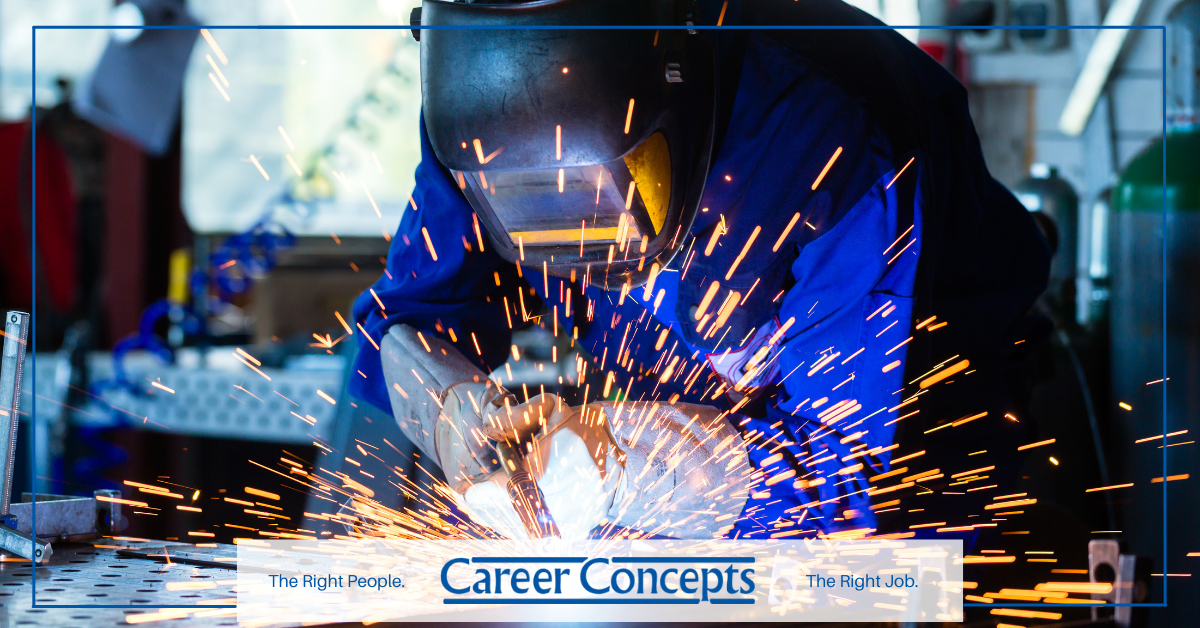
MIG welding is a process that uses a spool of wire continuously fed into a MIG welding gun from a tank usually filled with a mixture of Metal Inter Gas (hence, MIG welding). MIG is the fastest and most efficient form of welding, with minimal clean-up. It’s great for multiple passes in welding, requires less skill and technique, and has a much lower rate of toxic fumes than other kinds of welding.
In today’s post, we will outline some of the most important hard and soft skills for MIG welders seeking employment.
Key Hard Skills Needed for Mig Welders
- Blueprint Reading: Understanding blueprints and technical drawings is crucial for welders.
- Metal Properties Knowledge: A good welder should understand the properties of different metals and alloys, including their melting points, tensile strength (the maximum stress a welded joint can withstand before breaking under a pulling force), and how they react under heat.
- Equipment Maintenance: Welders should be knowledgeable about basic maintenance procedures and troubleshooting techniques to prevent equipment failures.
- Technological and tool-handling skills: Welders work on a wide variety of projects, and their tasks vary depending on each project, meaning that they will need to be familiar with a wide range of tools and devices and identify which piece of equipment is appropriate for each job.
- Welding Symbols and Codes: Welders should be familiar with welding symbols and industry codes, such as those set by the American Welding Society (AWS). These standards are a guide for producing consistent and high-quality work that complies with industry regulations.
- Hands-On Experience: Most employers seek candidates with a proven track record in various welding techniques and materials, which ensures that they can handle complex tasks with expertise.
- Mathematical and Spatial Reasoning Skills: Basic math skills are essential for measuring materials accurately and calculating angles or dimensions needed for welding projects.
- Physical Capabilities: Welders need to be in good shape and possess physical endurance to perform their role successfully. Welders must stand for long periods in extreme temperatures and carry heavy objects, as well as bend and twist to reach a position from which to work. In addition, they will need to hold their torches in a steady position for long periods of time, which requires a firm grip and a steady hand. Some relevant physical skills for the role are:
- Hand-eye coordination
- Strength and endurance
- Dexterity
- Good vision
- Good mobility and flexibility
Key Soft Skills for Mig Welders
- Teamwork and Collaboration: Welding projects often require collaboration. The ability to work well with others, share knowledge, and support team members is vital.
- Communication Skills: Welders need to communicate with supervisors, coworkers, and clients to ensure that everyone is aligned on project specifications and timelines, reduce the risk of errors, and enhance workflow efficiency.
- Problem-Solving and Critical Thinking: Effective problem-solving and critical thinking can result in smoother project execution. These skills enable welders to swiftly adapt to unforeseen challenges such as misaligned parts, improper fits, and defective materials.
- Attention to Detail: Even minor errors can compromise the strength and durability of the weld. Attention to detail is vital in ensuring that welds are clean, safe, and also meet industry standards.
- Safety Awareness: Welders must understand how to use and maintain personal protective equipment and always adhere to OSHA regulations. Welders should also be proficient in hazard recognition to maintain a safe working environment. Lastly, they should receive training in emergency preparedness, enabling them to make quick decisions that protect both themselves and others.
- Adaptability: Welders should be able to adapt quickly to changes in project specifications or client requests. They may also need to adjust their techniques when working with different materials, equipment, or environments.
- Problem-Solving Skills: Welders often encounter unexpected challenges, such as material inconsistencies or fit issues. The ability to quickly diagnose and resolve these problems is essential for maintaining productivity and ensuring the quality of the work.
As you can see, welding requires dedication and hard work, but mastering these hard and soft skills will make you more attractive to future employers and help pave the way to success in your career as a MIG welder!
Career Concepts is an MIG Welder’s best friend when searching for a position. We've been helping the right people find the right job for over 50 years! Give us a call today, and let's get started!
Blog published date
Share this blog
Categories
Career Concepts Blog